

Exhaust
Introduction to Modular Welding in Custom Fabrication
Custom fabrication shops thrive on precision, speed, and adaptability. However, many still rely on outdated welding setups that hinder efficiency and reduce overall output. Fortunately, the modular welding table has emerged as a transformative solution for shops aiming to maximize productivity without compromising quality.
Whether you’re building custom frames or one-off components, the ability to quickly reposition, align, and secure your materials is crucial. That’s why modern modular systems like Forster America welding fixtures offer unmatched flexibility and repeatability, creating opportunities for leaner, faster operations.
Common Problems in Fabrication Workflow

Before exploring solutions, let’s outline the common issues that plague custom fabrication environments. To begin with, setups are often time-consuming for unique or complex weldments.
- Time-consuming setups for unique or complex weldments
- Limited repeatability, leading to rework or inconsistencies
- Inefficient space usage, especially in smaller or high-mix shops
- Workholding challenges, particularly with irregular geometries
- Lack of scalability with fixed jigs or outdated welding benches
Additionally, limited repeatability leads to costly rework. Inefficient space usage, especially in high-mix shops, reduces overall productivity. As a result, these bottlenecks aren’t just inconvenient, they’re costly.
Reasons to Buy A Modular Welding Table
Let’s take a closer look at how modular welding tables improve productivity, particularly when paired with Forster America welding fixtures.
Enhanced Weld Project Setup Efficiency
Time spent preparing the table for each project is drastically reduced. Modular systems support:
- Quick-change setups
- Pre-configured jigs for recurring jobs
- Tool-less fixture adjustments
For example, with Forster clamping systems, setting up a complex weldment can take minutes instead of hours. While ease of set up is critical, you still might find yourself asking this next question.
Does a Welding Table Improve Accuracy and Consistency?
Absolutely. The flatness of these tables, often within ±0.1mm, allows for:
- Consistent tack and weld points
- Reliable squareness and angular alignment
- Reduced distortion and rework
This precision ensures tight tolerances are maintained across batches; non-negotiable for aerospace or medical fabrications. Moreover, this accuracy plays a critical role in catching problems before they escalate into costly rework or defective assemblies.
As noted in a recent ScienceDirect study, monitoring and anticipating manufacturing anomalies early has become a key trend in modern fabrication—an area where precise fixturing plays a preventative role.
While the benefits of modular welding tables are clear, not every table offers the same level of precision, flexibility, or ease of use. In fact, some common designs have built-in limitations that can affect both productivity and quality.
Learn how certain modular welding tables can actually hold your operation back—and discover how to avoid these pitfalls as we break them down next.
Understanding A Modular Welding Table, And Its Limitations
Modular welding tables are the backbone of high-mix fabrication shops, enabling greater speed, repeatability, and workflow agility. The majority of modular tables on the market use a fixed borehole grid, typically with 50mm or 100mm spacing, which supports basic fixturing but imposes major workflow constraints:
- Limited Clamping Locations: Grid tables force all fixtures to align with predefined boreholes, making setups for complex or irregular parts slow and frustrating.
- Cumulative Tolerance Issues: Even minor imperfections in grid or hole placement can cascade, causing alignment errors and costly rework.
- Workflow Bottlenecks: With every part change, teams must spend non-productive time reconfiguring setups, undermining the promise of “modularity.”
- Creativity Constraints: The rigidity of a borehole grid stifles truly custom assembly or unique project needs.
This plateau in productivity is exactly why forward-thinking metal fabricators are moving to next-generation, patented systems like Forster America.
How Do Fixed, Modular, and Forster Tables Stack Up?
Want a quick snapshot? Here’s how fixed, standard modular, and Forster modular welding tables compare across the four factors that matter most in fabrication.
Fixed Table
- Flatness: ±1.0 mm ✗
- Max Load: 1.5 t –
- Setup Time: 60 min ✗
- Accuracy Loss: 0.5 mm ✗
Standard Modular
- Flatness: ±0.1 mm •
- Max Load: 2.0 t •
- Setup Time: 25 min •
- Accuracy Loss: 0.2 mm •
Forster Modular
- Flatness: ±0.05 mm ✓
- Max Load: 3.5 t ✓
- Setup Time: 10 min ✓
- Accuracy Loss: 0.05 mm ✓
Forster America: Where Innovation Meets Proof
Forster America’s modular welding tables break every grid-based limitation, delivering unmatched flexibility, performance, and industry recognition that generic platforms simply can’t match.
Proven Superiority: Flatness, Load, and Endurance
- Certified Precision: Every Forster America table is engineered and inspected to ISO 2768T2 standards, delivering a certified rail surface flatness of ±0.05 mm. This sets a new industry benchmark, twice as precise as most competitors’ “0.1 mm typical” claims.
- Heavy-Duty Capacity: Forster’s designs handle point loads up to 1.5 metric tons and distributed loads up to 3.5 metric tons (model dependent), ensuring flawless performance for heavy fabrication, structural steel, and aerospace jobs.
- Lifetime Surface Integrity: The high graphite content of Forster’s proprietary gray cast iron, and aluminum-copper alloy (Al/Cu) for stainless projects, prevents weld spatter adhesion and maintains precision, even after years of demanding use.
Patented T-Slot System: Freedom Without Grid Restrictions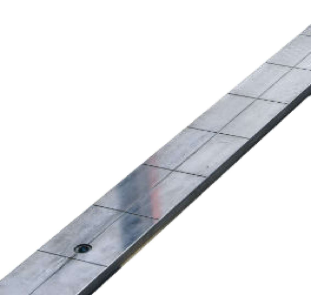
- True Infinite Positioning: Forster’s patented T-slot surface, adapted from high-precision CNC machine tool engineering, allows any clamp or stop to be placed continuously along the slot; completely eliminating grid and intersection constraints.
- Rhombus Groove Stone: The Ultimate Flexibility
Unlike generic T-slot systems, Forster’s exclusive rhombus groove stone enables accessories to be inserted anywhere along an open T-slot, even in the middle of the table, without having to remove other fixtures. This unique feature dramatically speeds up setup and reconfiguration, giving your team genuine flexibility and minimizing non-productive time. - Minimal Tooling, Maximum Modularity: Forster’s entire clamping and accessory system is designed for tool-less, rapid configuration; most adjustments require nothing more than a standard hex key.
Advanced Surface Profiles: X-Pro and Double Groove Options
- X-Pro Profile: Lightweight anodized aluminum surface designed for mobile and reconfigurable setups. Delivers high strength with minimal weight, making table repositioning fast and effortless.
- Double Groove Profile: Dual parallel T-slots in each rail maximize accessory placement and clamping flexibility; ideal for complex or multi-stage weldments.
- Universal Compatibility: All profiles accept the complete range of Forster T-slot clamping and stop elements for seamless modularity and continuous positioning.
- Premium Materials: Choose from high-strength gray cast iron for heavy-duty projects or aluminum-copper alloy (Al/Cu) for stainless steel fabrication, each delivering industry-leading flatness and thermal stability.
Intelligent Engineering & Award-Winning Ergonomics
- Ergonomics Recognized Worldwide: Forster’s innovations have earned multiple honors, including the prestigious Bavarian State Award and Federal Award for Outstanding Innovative Achievements in the craft and industrial sector. These awards, given at the International Industry and Craft Fair Munich, recognize ergonomic, modular, and automation-friendly design that goes far beyond the average welding table.
- Endlessly Customizable: From stationary to mobile, lift, turn, tilt, and large-format frame welding tables, Forster’s modular platforms and accessories adapt to every shop, every job, and every future upgrade.
- Made in Germany, Supported in the USA: Over 35 years of engineering and manufacturing in Germany, backed by dedicated U.S. support, on-site training, and comprehensive service.
Forster America vs. A Traditional Grid-Pattern Modular Table
| Feature | Forster T-Slot System (Patented) | Borehole/Grid System (Competitors) |
| Fixture Positioning | Continuous, infinite; anywhere along the slot | Fixed to borehole grid intersections |
| Accessory Insertion | Insert at any open slot (rhombus groove, even if partially full) | Only at grid or slot ends |
| Surface Flatness | ±0.05 mm, ISO 2768T2 certified | 0.1 mm typical, not always certified |
| Load Capacity | Point loads up to 1.5t, distributed up to 3.5t (model dependent) | Lower, less consistent |
| Fixture Versatility | Reversible fixtures; universal left/right | Left/right fixtures sold separately |
| Setup/Reconfig Speed | Tool-less, instant, no specialty tools required | Frequent resets, manual rework |
| Material Science | Graphite gray cast iron, Al/Cu for SS; lifetime surface integrity | Standard steel or iron, spatter issues |
| Long-Term Value | Modular, scalable, lifetime ROI | Limited, higher accessory churn |
Recognized Industry Leadership
Forster America is trusted by leading fabricators, manufacturers, and metalworkers worldwide, a legacy proven by over three decades of innovation, ISO-certified engineering, and global recognition for technical achievement.
In Summary

Forster America modular welding tables are not just a productivity upgrade, they represent a leap in precision, efficiency, and shop safety. If your team is ready to break free from grid-based limitations and invest in award-winning, future-proof technology, the choice is clear.
Partner with Precision Welding Group and Forster America for the last welding table system you’ll ever need.
Frequently Asked Questions About Modular Welding Tables
Looking to Increase the Quality, Efficiency, and Consistency of Your Welds? Forster Modular Welding Tables at Precision Welding Group are the Way to Go.
Modular welding tables offer a path to increased productivity, repeatability, and profitability. By leveraging tools like Forster America welding fixtures, shops can dramatically reduce waste and improve project outcomes. Ultimately, these tools are not just a purchase; they’re a long-term investment in the success of your operation.
Whether you’re expanding your capacity or improving your workflow, modular welding systems are a smart investment. At Precision Welding Group, we’ve seen firsthand how these innovations empower teams and transform shop floors.
Ready to modernize your welding process?
Take the Next Step Towards Success Here.


